COVID-19 Daily Update for Yesterday, Sunday, 8/23/2020:

COVID-19 Daily Update for Yesterday, Sunday, 8/23/2020:

World Wide Trends in Brief: 

In today's installment of "is it signal or is it noise", let's look at the World Wide daily change in the number of active cases. 

Active Cases are defined as the number of cases - number recovered. So the daily change in active cases, is the number of new cases that day, minus the number of people who have recovered that day. In other words, it's the orange line, minus the green line below:

When it's positive (when the orange line is above the green line) the number of active cases world wide are growing. When it's negative (when the green line is above the orange line) the number of active cases world wide is shrinking. 

When we plot that difference, we see that with a 7 day trend, the daily change in the number of active cases shrank for a while, but is now starting to grow again: 
However, with a 14 day average, the daily change in the number of active cases is still smoothly falling:
Remember that even if this line is heading downward, as long as it is positive, things are getting worse. It needs to be negative before things are getting better. That being said, are things getting worse at a decreasing rate (14 day average)? Or... are things starting to get worse at an accelerating rate (7 day average)? 

This question (is it signal, or is it noise) is one of the KEY questions of statistics. And it is not at all easy to answer. 

Given that there are strong "weekend" effects, we know we should be taking moving averages of the data in increments of 7. (With less than that you start to see weekly fluctuations that make the interpretation even more difficult). However, a 7 day average is potentially too small of a chunk, and it can be impacted by noise which makes you think you are seeing a new "trend" when you aren't. However, the 14 day average is too large, because it can hide trends that are, in fact, real, and you have to wait at least two weeks to be sure that something real has changed. Neither is ideal... and I would prefer something like a 10 day average. But the weekend effects make that even more problematic than either the 7 or the 14 day averages. 

This is a BAD idea, but I will show you what it looks like anyway: 
It is POSSIBLE that the right thing to do would be to create a complicated model of the weekend effect, then take it out of the data, correcting for it... then take a 10 day average, and see what the trend says. But the strength of the weekend effect depends on which country is reporting the most cases at the time (some have a stronger weekend effect than others) so correcting for this is a moving target! It's potentially impossible to really get right. 

So instead... we are just going to have to wait... watch... and see where this trend goes in the next week or so. 

Did I mention that I hate waiting?


COVID-19 Daily Update for Yesterday, Thursday, 8/20/2020

COVID-19 Daily Update for Yesterday, Thursday, 8/20/2020:

World Wide Trends in Brief:

Major world wide trends from my last update are largely continuing. 

Percent daily growth in active cases has been falling, but is now holding at around 0.25%/day:
There have been two days with large outlier reporting spikes that make interpreting the daily deaths difficult, but the trend seems to be down since late July:

Compilation of Data Sources: 

I am in the process of compiling some of the best computer readable data sources for COVID-19 modeling out there. This is a work in progress, but for those interested, here's a link to the document which will likely grow through time. Eventually I hope to wrote code to auto-scrape many of these resources, and I will provide a link to that code once it's available. 

If you are aware of a good data source that I have missed, leave it in the comments here, or feel free to send me an email, or yell at me on FB or Twitter. 

Mis: 

I apologize that today's update is short, I have both a paper deadline, and a deadline for a presentation both due tonight. 

COVID-19 Daily Update for Yesterday, Wednesday, 8/19/2020:

COVID-19 Daily Update for Yesterday, Wednesday, 8/19/2020:

Yesterday's update was a "model talk" discussion about problems with rt.live's approach to estimating Rt.

Today is a more traditional status update. 

World Wide Trends in Brief: 


World wide we are starting to see minor signs of improvement. 

Daily cases peaked at the end of July, and have been falling VERY slowly since then. Because recoveries lag, they have continued to climb over the same period:
However, the number of new infections is still larger than the number of new recoveries, which means that the change in the number of active cases is still positive, meaning that more people are sick today than yesterday. But that trend has been moving down over time:
For the world to recover, this trend needs to be negative, and then stay negative. But there are still signs of improvement. 

We can also see improvement in the daily deaths, which have also been trending down since the end of July: 

Can it be Done, Watching China, New Zealand, and South Korea:

We have been especially watching three countries: China, South Korea, and New Zealand to see if their strategies for dealing with the virus is viable. China used a totalitarian lockdown, South Korea used extensive contact tracing with only minor restrictions, and New Zealand "went hard and went early" (without China's totalitarian bent) to stamp out all local transmission before reopening completely. 

All three were initially successful. All three are now facing local outbreaks that are challenging their strategies. If we wanted to prove to the rest of the world that there were alternatives to our failed approaches, these are some important places to watch. 

China's approach of local lockdowns of the affected regions appears to be working: 
New Zealand's second lockdown with contact tracing also now appears to be producing improvements:  

South Korea is still struggling to get its most recent Fundamentalist Church Based outbreak back under control. But they did it once. Now we need to see if they can do it again. It's currently too soon to tell: 

Source, Data, and Graphs:

https://docs.google.com/spreadsheets/d/1qVOdkuQ1IQb8McLNoe3oiSrnU1gVj7X916dvpyZ-zZY/edit#gid=737858658


COVID 19 MODEL TALK, RT.LIVE IS WRONG:

COVID 19 MODEL TALK, RT.LIVE IS WRONG:

I've been doing daily COVID-19 updates on facebook for a while now, and decided to move them to my blog. 

Today is a statistics and modeling thing, so if that is not your "thing" I promise to do a "status update" tomorrow. And I'll start putting in the title which I am doing each day. 

So... rt.live is wrong: 

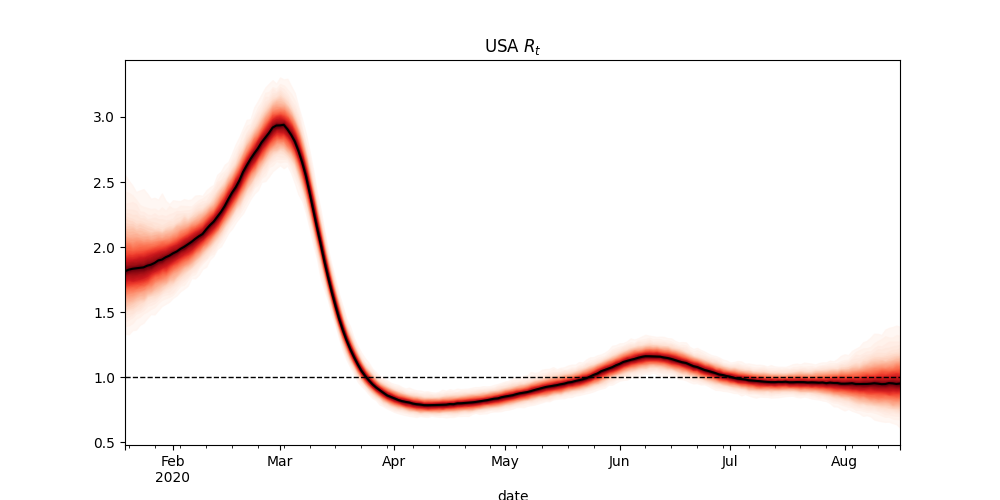
https://rt.live runs their algorithm on individual states, but never gives an average for the entire USA. It makes sense that they might not choose to do this, the outbreak in the US is quite diverse, and differs from place to place. But I think it's still a good idea to get the average over-all picture. 

Now that I have their code running on my local machine, I modified the code to run on the average for the US. The first two figures show my results. Remember, this is rt.live's algorithm, but run on data they don't normally show. 

The current estimate of Rt for the US is 0.96, with 80% intervals of 0.73 - 1.13. That seems reasonable. 

HOWEVER, their adjustment for testing rates is VERY aggressive. They estimate that cases were more than TWICE as high in April's peak as they were in July's second peak. 

I don't believe this is right. And if they get the case adjustment wrong, they will get their estimate of Rt wrong in general. I suspect that their CURRENT Rt is right, but their RT back in July is FAR too low. 

If you ONLY look at the daily death curve, you might suspect something like what rt.live is saying. BUT, if you look at the hospitalization curve, it is obvious that this isn't right. 

Instead... the case fatality rate has to be dropping. And that means that the second peak has to be at least as high as the first. I used to claim that the first was larger, because more people were being turned away at the hospitals, but after a conversation with  Youyang Gu over on twitter, I have changed my mind... a falling average age of infection means a lower fatality rate, but ALSO a lower hospitalization rate. And THAT would imply that the second peak should be LARGER than the first! 

Rt.live's second peak is not only not as large or larger than the first, it's MUCH smaller! This just CAN'T be correct. And that means that EVERYTHING else they are doing is also wrong. 

The last figure shows the range of ways that the case data (in blue) can be adjusted for tests. The red curve is Youyang Gu's adjustment (with the second peak much higher than the first). The Yellow curve is my adjustment, with the two peaks roughly equal in size based on the hospitalization data. (I now believe that Youyang Gu's estimate is likely better than mine). The green curve is from rt.live. Not only is it an outlier... it makes NO sense. 

Conclusion: rt.live is wrong. The way they adjust cases for testing rates seems to be FAR too aggressive. For their curve to be right, the Infection Hospitalization Rate (IHR) would have to be RISING DRAMATICALLY, while the Infection Fatality Rate would have to be staying the same. 

The reality is that both the IFR and IHR should be falling as the median age of infection falls, while the IFR should be falling faster than the IHR as treatments improve. 

To get a good and reliable estimate of Rt, I'm going to need to re-write the part of their code that adjusts for testing rates. 

(Here's a link to Youyang Ug's discussion of how he adjusts for testing rates: https://covid19-projections.com/estimating-true-infections/)

Ferguson, Uncertainty, and a Way to Move Forward

I have been silent about the Ferguson matter so far, but I think it's time that I try to articulate a few of my thoughts on this matter.

Before I begin, I want to get something out of the way first. No matter what happened between Darren Wilson and Michael Brown, there is no doubt in my mind that race is an issue in our law enforcement. The reactions of people across the country to this event very clearly demonstrates that fact. People of color in our society simply do not feel protected by the police force that surrounds them, rather, they feel threatened by them. And this is a situation that simply must change moving forward if we want to create an ethical, equitable, prosperous, and peaceful society moving forward. And that fact will remain true, regardless of what actually happened in this single instance between Darren Wilson and Michael Brown.

With regard to those specifics, many people have taken to the internet to tell us exactly what did happen that night, and why they think they know what "really happened". But that is not what I will do. The simple fact is that if Darren Wilson's account of events that night is accurate, then the right decision was reached, and he was innocent of any serious wrongdoing. However, if some of the other eyewitnesses accounts of the events of that night are accurate, then Darren Wilson murdered Michael Brown in cold blood, and a very serious miscarriage of justice has taken place in this instance. And there are extraordinarily compelling reasons not to believe either Darren Wilson's account, or that of the other eyewitnesses testimony. Several of the eyewitnesses testimonies were later refuted by the forensic evidence (for example, testimonies about Michael Brown having been "shot in the back" simply do not match the forensic evidence). The simple fact is that the testimony of witnesses is by far the least reliable source of evidence imaginable. Many innocent people have been sent to prison based upon eyewitness testimony, only to later be exonerated by evidence such as DNA evidence, that simply does not make the sorts of mistakes that eyewitnesses do. And that fact means that both the testimony of Darren Wilson, and that of those others who saw the event are ultimately unreliable.

The result of this, is that I simply do not know if Darren Wilson murdered Michael Brown or not. And I believe that the certainty with which some others (on both sides) have approached this situation is largely unwarranted. So, what am I here to tell you? If I am not here to tell you who to believe, who is right, or whether justice was done, then what am I here to say? I am here to say that I don't know who is right, or what happened, but I do know how to be absolutely sure that this uncertainty does not happen again. I am here to tell you how we can know what happened next time, and how we can make sure that a repeat of this never happens again. And that answer is surprisingly simple.

Every police officer should be required to wear a body camera while on duty and while interacting with the public. Every time. Every police officer. Everywhere. Always. And when this happens we will never again be forced to say that we don't know for sure what happened. We won't have to say that we don't know whether or not justice was done or not when a police officer is not charged in a shooting death. When police officers are innocent of wrongdoing, that will be demonstrated by the camera. When they are guilty of wrongdoing, that too will be shown by the camera. The camera protects both the officer from false accusations, and the public from police abuse. And while knowing what happened after the fact is important, it is perhaps even more important that cameras can actually prevent incidents from ever happening in the first place. Both instances of abuse from police and of bad behavior from those they interact with will go down because both parties will know that they are being recorded, and that the truth of what they are doing will be known. People simply behave differently when they know that they are being watched. And evidence suggests that the use of police cameras can drastically reduce both the incidents of police use of force (up to 50%), and can drastically reduce the incidents of complaints against officers.

Now, this will not solve all our problems with police abuse in this country. And it certainly won't solve all our problems with race in this country either. But it is a start. And we simply must begin somewhere.

This is an idea, who's time has come. Let's make it happen.

Roadblocks to the Singularity?


Book review of "Physics of the Future: How Science Will Shape Human Destiny and Our Daily Lives by the Year 2100" by +Michio Kaku.

This was a fun book, but I believe that he is wildly overly pessimistic with regard to his predictions concerning strong AI.

He proposed six "roadblocks to the singularity" which I would like to respond to in turn. He writes:

“No one knows when robots may become as smart as humans. But personally, I would put the date close to the end of the century for several reasons."

First, the dazzling advances in computer technology have been due to Moore’s law. These advances will begin to slow down and might even stop around 2020-2025, so it is not clear if we can reliably calculate the speed of computers beyond that…"

I believe that there are three reasons that this is incorrect:

1. We don't know if the new paradigms that could replace Moore's law will allow faster or slower continued growth, so things could get better not worse... depending.

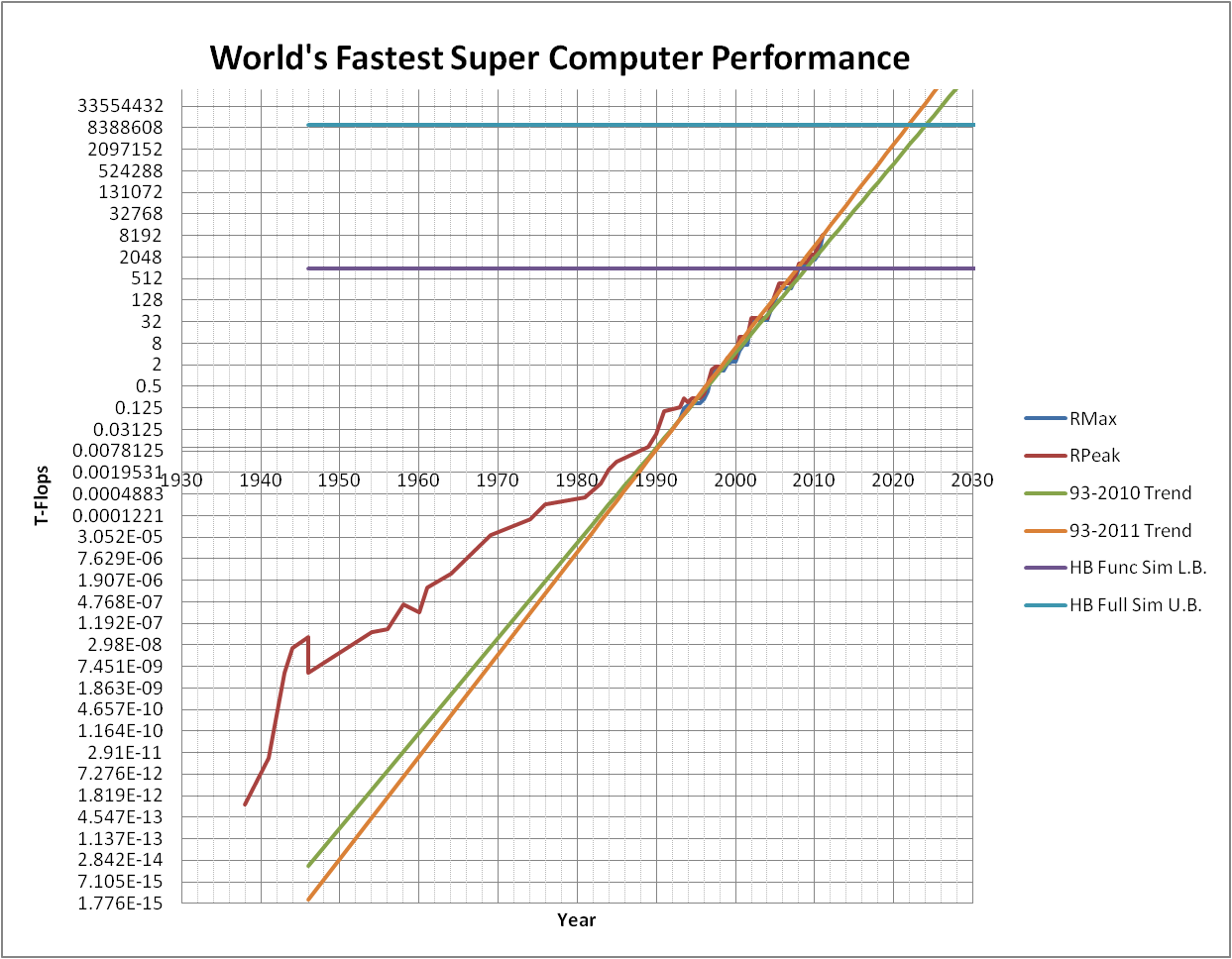
2. Parallel computing could allow increased performance even if there is no immediate successor to Moore's law. For example, power consumption / flop continues to drop exponentially

(https://picasaweb.google.com/jlcarroll/Economy#5613003695780064354), and the Brain is a proof by example that it can get down to around 20 wats/10^19 cps... If that trend alone continues, then super computers will continue to increase in performance, even if Moore's Law comes to a screeching halt
(https://picasaweb.google.com/jlcarroll/Economy#5618931828657988610).

3. If you look at my graph, super computers will achieve 10^19cps (the upper bound of the computing power of the brain) just after his 2020 deadline, so it will be too late for the end of Moore's law to stop the creation of strong AI

(https://picasaweb.google.com/jlcarroll/Economy#5620432299391054642).

Second, even if a computer can calculate at fantastic speeds like 10^16 calculations per second, this does not necessarily mean that it is smarter than us…

“Even if computers begin to match the computing speed of the brain, they will still lack the necessary software and programming to make everything work. Matching the computing speed of the brain is just the humble beginning.

To which I respond: That is strictly true, but if we have enough calculations for one computer to simulate the other computer (in this case the human brain), then that computer will indeed be as "intelligent" as the other. The only question is whether such a simulation will be possible, and if so, when it will be possible... more on that later.

Third, even if intelligent robots are possible, it is not clear if a robot can make a copy of itself that is smarter than the original.…John von Neumann…pioneered the question of determining the minimum number of assumptions before a machine could create a copy of itself. However, he never addressed the question of whether a robot can make a copy of itself that is smarter than it…

“Certainly , a robot might be able to create a copy of itself with more memory and processing ability by simply upgrading and adding more chips. But does this mean the copy is smarter, or just faster…"

It can be trivially shown that a computer/robot can indeed create a new computer/program/robot that is smarter than itself. The fact that Neumann didn't do it doesn't make it any less trivial. How do you do it?

Let's start with human examples, then discuss hardware improvements (assuming that there are no software improvements beyond the brain simulation algorithm), and finally we will discuss whether a computer can make software improvements to its own algorithm.

Humans easily create programs that are "smarter" than the programmer. For example, it is possible for me to easily write a checkers program that plays checkers better than I do. So if you consider intelligence as a multi-dimensional thing, it is clearly possible for an agent to create a new algorithm that is smarter in one or more dimensions of intelligence than itself, with a proof by example (I do it all the time).

Next, hardware improvements:

Michio Kaku admits that a robot can create a copy of itself with more memory and processing ability, but he doubts that such a computer should be called "more intelligent." However, if the robot built a copy of itself with twice the parallel processing power, and if that computer was intelligent by running a simulation of the brain, then it would indeed be more intelligent than before. Why? simple. It can now simulate two brains at the same time, or it can simulate one brain twice as fast (getting twice as much work done on a problem per thinking time spent). No one doubts that two people collaborating on a problem do a better job than one, or that one person who spends twice as much time on a problem gets more done on it.

This can happen because we are simulating the brain with chips that run at about 10^-9 sec, while the human brain fires each neuron at 10^-3 seconds. That means that at first, each processor will be simulating multiple neurons. If you then have twice as many processors, you get to have each chip simulate less neurons, and voila, you can now speed up the simulation considerably, or run multiple simulations at the same time. This doesn't scale up perfectly, nor does it scale up forever, but it will work for quite a while, until we hit limits around where we have one processor for each neuron or synapse (depending), each one running at 10^-9 seconds, and then you may hit something of an impenetrable wall to making the simulation of a single brain go faster. But that still gives us about 10^6 levels of improvement beyond human level intelligence before we hit that wall. Furthermore, after that wall you can still simulate more brains and have them collaborate, each one working on a different part of the problem. That type of scaling should continue roughly forever. Unfortunately twenty people are not always twice as good at solving a problem than ten, so this type of improvement may eventually create diminishing returns. Yet after that limit is reached, it would be possible to put each brain simulation to work on a completely different problem, essentially doing two different things at once. The exact limits to this type of scaling appear to be a very long way off, and all of this assumes that somewhere along the way, we won't find a faster way to do what the brain does, or find a better means of allowing separate minds to collaborate and cooperate in parallel.

It seems to me that we must admit that an AI brain simulation that can do nothing more than add processors to itself is indeed "more intelligent" by any reasonable description of the term.

Now for the issue of software improvements:

Can a simple software program make a copy of itself that is "smarter" than itself? It is trivial to show that this is true. ALL machine learning algorithms are algorithms that "improve" on themselves over time. If they copied their state at one point in time, and then copied their state at a later point in time, then they just created a copy of themselves that where smarter than their previous incarnation.

But it gets better than this. It is possible to work on a meta learning algorithm that "learns to learn", meaning that the AI isn't just better at each problem because it has incorporated more data, but it becomes better at the fundamental problem of how to incorporate data over time. Or it is possible to use the computer to create a genetic algorithm that improves its own algorithms etc. There are thousands of ways in which it is possible for one piece of software to create another that is "smarter than itself." Studying this issue is an entire sub-field of machine learning that goes under the title "Meta-Learning" and "Transfer Learning" and "Learning to Learn". My master's thesis was on this issue and it is unfortunate that Michio Kaku appears to be completely ignorant of this entire field, or he would not have raised such a silly concern. (In his defense, he is a physicist not a computer scientist, however, if he is going to write about someone else's field, he could have at least consulted someone in that field that could have explained to him that he was not making any sense).

“...fourth, although hardware may progress exponentially, software may not…

“Engineering progress often grows exponentially… [but] if we look at the history of basic research, from Newton to Einstein to the present day, we see that punctuated equilibrium more accurately describes the way in which progress is made."

The data seem to indicate that this is not true. If anything, software performance and complexity is growing faster than hardware performance (see http://bits.blogs.nytimes.com/2011/03/07/software-progress-beats-moores-law/).

Furthermore, although I will grant him the idea of punctuated equilibrium, if you step back and view the trends from a distance, it often becomes clear that punctuated equilibrium is nothing more than the steps on a larger exponential trend. Most importantly, software builds on software. Each programming language from machine language, to assembly language, to a compiler, to modern interpreters, to complex and re-usable object libraries, to the current work being done by some of my colleges on statistical programming languages, provide abstractions hiding the complexities of the lower levels from those programming at the upper levels. This trend appears to be continuing, and it is this "building" effect that produces exponential progress.

Fifth, … the research for reverse engineering the brain, the staggering cost and sheer size of the project will probably delay it into the middle of this century. And then making sense of all this data may take many more decades, pushing the final reverse engineering of the brain to late in this century."

Yes, it will be complex, and yes, it will be expensive (his two central complaints). But he admits elsewhere in his book that it could clearly be done quite rapidly, the only roadblock being the money it would cost. He then makes the absurd claim that there is less perceived "benefit" to be derived from such a simulation, so people won't invest the capital needed to create that simulation. I believe that this is short-sighted. There are many commercial applications for each step along the road to this simulation, and they will only grow as we get closer (see http://www.youtube.com/watch?v=_rPH1Abuu9M). In fact, I believe that there are more potential economic benefits for this work than perhaps for any other in human history. Surely someone else besides me will see the potential, and the funding will flow.

There are many projects working on completing this monumental task, and several are proposing a time line involving around 12 years (incidentally, that is about when my projection of super computer power crosses the upper bound for running this simulation). See: http://www.dailymail.co.uk/sciencetech/article-1387537/Team-Frankenstein-launch-bid-build-human-brain-decade.html#ixzz1Rp7JEF4R and http://www.youtube.com/watch?v=_rPH1Abuu9M.

Our tools for this task are improving exponentially. Our computer power needed to perform this simulation is growing exponentially, our brain scan resolution is growing exponentially http://www.singularity.com/charts/page159.html as is the time resolution of these scans http://www.singularity.com/charts/page160.html.

He does raise another concern related to this one, which I should address:

“Back in 1986, scientists were able to map completely the location of all the nervous system of the tiny worm C. elegans. This was initially heralded as a breakthrough that would allow us to decode the mystery of the brain. But knowing the precise location of its 302 nerve cells and 6,000 chemical synapses did not produce any new understanding of how this worm functions, even decades later. In the same way, it will take many decades, even after the human brain is finally reverse engineered, to understand how all the parts work and fit together. If the human brain is finally reverse engineered and completely decoded by the end of the century, then we will have taken a giant step in creating humanlike robots.” (Michio Kaku “Physics of the Future, How Science will Shape Human Destiny and our Daily Lives by the year 2100” p. 94-95).

We already mapped the brain connections of several very simple animals, but are currently unable to turn this map into an intelligent working simulation. So it would appear that our hardware creates the potential for brain simulation long before our software catches up and is actually capable of performing the simulation. This is the root of his concern.

However, there are a finite number of types of nerve cells, and hormonal interactions that take place in the brain. Once we understand their behavior better, and once we create the algorithm for simulating them, after that moment, it is only a matter of scale and creating the larger more complex neural map. In other words, there is a gap between simulating individual neural behavior and mapping neural connections. Apparently, we can not yet simulate a single neuron's interactions appropriately, and so, knowing the network of connections for these neurons in C elegans is not as helpful as it at first might sound. We will not be able to truly simulate the worm's brain until we solve this problem, and we will not be able to truly simulate the human brain until we solve this problem. But once we can simulate these finite types of neurons correctly, we will be able to accurately simulate the worm's brain, and the human brain as well, once a neural map is created, (and once our computers become sufficiently powerful).

It is my opinion that we will solve this individual neural simulation problem long before we will fully map the human brain. I believe that will take much longer. Why do I believe that we will be able to crack the behavior of neurons so soon? Because first, the complexity of this algorithm is limited by the human genome and its associated expression mechanisms, and second, current progress in this area is quite promising, and it appears that we are currently quite close.

I actually believe that simulating the brain is a much harder problem that do extreme optimists such as Ray Kurzweil who thinks we will be doing this sort of simulation around 2019 (based on the idea that the functional simulation is less complex than the full simulation, which we won't be able to do until 2023 at the earliest). On the other hand, I believe that we will need to do the full simulation first, and then explore that for quite some time before we understand how it is working. But that only pushes things back to 2050 at the latest. Michio Kaku's assertion that 2100 will come, and go, and strong AI will still be years away seems a bit silly to me.

Michio Kaku's sixth and final argument against the singularity is:

Sixth, there probably won’t be a ‘big bang,’ when machines suddenly become conscious…there is a spectrum of consciousness. Machines will slowly climb up this scale.”

This isn't really a roadblock to the singularity. Every Singularitarian that I know agrees with this. None of them believe that some magic moment will hit and everything will change. They believe that change will accelerate until you won't be able to keep up without merging with our technology and transcending our biology, so this "roadblock" is inaccurately named, and rather irrelevant.

Consciousness, Information, and the Interpretation Problem

One of the greatest mysteries of modern science involves understanding the nature of consciousness. There are currently many competing theories for the origins of consciousness. Although a clear solution is not yet in sight, nevertheless, there are many things that I believe that we can say about the problem now.

Two competing popular theories of consciousness are Material Property Dualism (MPD), and Functional Property Dualism (FPD). Both FPD and MPD are a variety of Property Dualism, that claims that something "more" than the structure and dynamics of physics is needed to explain consciousness. MPD claims that consciousness is inescapably tied to the matter that makes up our brains, while FPD claims that it is only the functional properties of our minds that is important, and that a simulation of a brain on a computer would thus have the same subjective experiences as does the biological brain. Personally, I prefer neither of these camps, but instead subscribe to a form of Representational Functionalism (RF), that claims that nothing more than the structure and dynamics of physics is needed for consciousness. Nevertheless, I think that there is value in comparing the arguments for MPD with those for FPD, since I believe that there are compelling reasons to prefer FPD over MPD if one is forced to chose between these two theories.

A major criticism of the computational model of consciousness raised by Material Property Dualists, against both FPD and RF, is that all information must be "interpreted" before it could mean anything, or have qualia or consciousness, while Functional Property Dualists claim that it is the functional properties of the system that carries the dual properties that lead to consciousness. MPD posits that only matter can carry the "property" of consciousness, a "dual" property, beyond its causal properties, which form the structure and dynamics of physics. It is easy to understand why they feel this way. After all, why would nothing more than a bunch of ones and zeros have any subjective experience, no matter how much complexity is contained in the organization of the ones and zeros. This is all very intuitively pleasing. And a similar argument seems to show that the structure and dynamics of physics alone shouldn't lead to experience either. It should lead to all the behavior we have, including our claims to experience, but (these people argue) one can imagine all that structure and dynamics taking place like the wheels of a clock, completely absent any subjective experience. RF, which I prefer, responds to this criticism by claiming that nothing "more" than the structure and dynamics of physics is actually needed, even though it intuitively feels like something more is needed (our intuitions are wrong). In contrast, FPD gets around this argument by admitting that something "more" is indeed needed, but they tie the "more" to the information/functional properties of the system instead of to the matter. Supporters of MPD usually respond to this argument by claiming that the information in the functional system needs something to help "interpret" it correctly, and that the ones and zeros by themselves are simply random bits of information, with no proper interpretation, and thus, with no experience. Thus, they claim that the "more" must reside in the fundamental properties of matter in some way.

On the surface, these arguments seem to be quite compelling. However, the Maxwell's Demon thought experiment, indicates something strange. We know from relativity that we can turn matter into energy and  vice versa. But now we also know that we can also convert INFORMATION into matter or energy and vice versaThis has important implications for the whole consciousness debate between MPD and FPD. 

Why? Because it seems to mean that the universe is made of something fundamental, namely matter / energy / information, and that these three things are nothing more than three different manifestations of the same fundamental entity. Much as water, steam, and ice are all different manifestations of the same fundamental entity. Thus, if matter can carry some "fundamental" interpretation that allows consciousness (as MPD claims), then so can information (as FPD claims). And there is no reason to suppose that matter is any "better" at carrying this fundamental property that allows for the interpretation of experience than is information. Therefore, inasmuch as the single objection to FPD (proper interpretation) has been removed, and there are compelling reasons to prefer FPD over MPD (we haven't found any evidence of specific materials that perform this function in the brain, and David Chalmer's "fading qualia" and "dancing qualia" thought experiments STRONGLY indicate that consciousness must be found in the functional aspects of the brain, not in its material properties), it seems that we should all now prefer FPD over MPD.

This observation doesn't say much about the continuing debate between Representational Functionalism (RF) and FPD, (where I strongly prefer RF for reasons related to the epiphenomenalism argument). However, it does indicate that MPD should largely be removed from consideration as a potential solution to the problem of consciousness. The remaining debate must largely be between Functional Property Dualism and Representational Functionalism. 

Groundhog's Day and the Meaning of Life

Yesterday was Groundhog's Day, the holiday where everyone waits with baited breath for a rodent to decide if it saw its shadow, and ther...